Iris
Multi-class classification of the 150 iris flowers into their three species, from four measurements. The tutorial is the smallest of the five: it trains in seconds on a CPU and ends with a network of one neuron. The classification quickstart builds a similar model step by step.
The script is tutorials/iris/iris_recognition.py, its configuration
tutorials/iris/iris.yaml. A notebook version,
tutorials/iris/iris_recognition.ipynb, draws the plots inline. The
script needs the viz extra: it plots the layer errors and the confusion
matrix with matplotlib and draws the network with Graphviz.
Data
The script loads iris from scikit-learn and interleaves the three species, so that each run of three rows holds one flower of each. The first 70% of the rows train the neurons (105 flowers), the next 15% are the dev split (22) and the last 15% the test split (23). The features stay in centimetres, unscaled.
The configuration
| Setting | Value | Why |
|---|---|---|
model.type |
multi-class |
three species |
model.soft_binner |
false | the class scores come from a learned projection shared by the candidates (see Classification) |
model.ref_functions |
linear_cov |
pair neurons \(w_0 + w_1 x_i + w_2 x_j + w_3 x_i x_j\) |
model.shortcut |
false | each layer reads only the survivors of the layer before |
model.nbest_neurons |
4 | survivors per layer |
model.max_neuron_models |
8 | above the 6 pairs that 4 inputs make, so every pair is tried; the log warns that the cap is clamped to 6 |
train.optimizer |
sgd, lr 1e-4, min_lr 1e-5 |
with batches of 30 rows |
train.steps, train.eval_step_interval |
900, 5 | |
train.max_layer_count |
5 | |
train.criterion_minimum_width |
5 | the search runs all five layers and keeps the best |
train.checkpoint_dir is checkpoints in this file, so each run's folder
goes into checkpoints/ in the folder the script is launched from, the
repository root with the command above (see
Training). Set it on the command line
to keep them elsewhere:
The commented-out entries of model.ref_functions in the file show the
other power-basis families; uncommenting one adds it to the search.
Results
Two runs on a CPU gave the same numbers, about 11 seconds each. The dev error of each layer:
| Layer | 0 | 1 | 2 | 3 | 4 |
|---|---|---|---|---|---|
| Dev error | 0.0789 | 0.2466 | 0.4239 | 0.2853 | 9.7661 |
The first layer is the best, so the model keeps one layer. It classifies all 23 test flowers correctly:
With 23 test rows, that shows the model works on this data; it is too few rows to measure its accuracy precisely.
The network
The script draws the network before and after pruning, into
iris_model.svg and iris_pruned_model.svg next to the script,
overwriting the copies in the repository. The four survivors of the one
layer read different pairs of measurements; after pruning, the prediction
comes from a single neuron that reads sepal length and petal length:
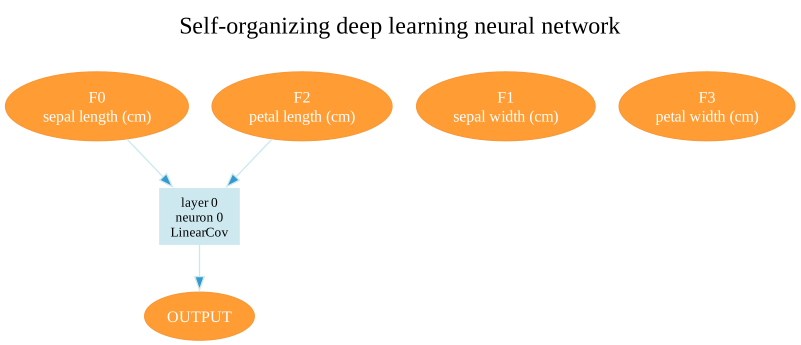
After pruning, the script prints the features the prediction uses: sepal length and petal length. Inspecting a model shows how to read the network.
Checked against TorchSONN 0.1.5.