Inspecting a model
A trained model is a small graph of polynomial neurons, and every part of it can be read. This page shows how to draw the graph, read the layer errors, list the features the model uses, look inside its neurons and read the training log. The examples use the model of the regression quickstart.
Drawing the network
PlotModel draws the network with Graphviz. It needs the viz extra and
the Graphviz programs (see Installation).
from torchsonn.plot_model import PlotModel

trainer.prune(model)
PlotModel(model, "california", plot_neuron_name=True).plot()
plot() writes the drawing to california.svg and its Graphviz source to
california, in the current folder. PlotModel(model, filename,
plot_neuron_name=False, view=False, title=...) takes three options:
plot_neuron_name=True writes each neuron's family into its box,
view=True opens the drawing once it is written, and title sets the line
at the top of the drawing, "Self-organizing deep learning neural network"
by default (None leaves it out). Without the Graphviz
dot program on the PATH, plot() raises RuntimeError.
This is the quickstart's model after pruning, a California housing network
built from linear_cov reference functions:
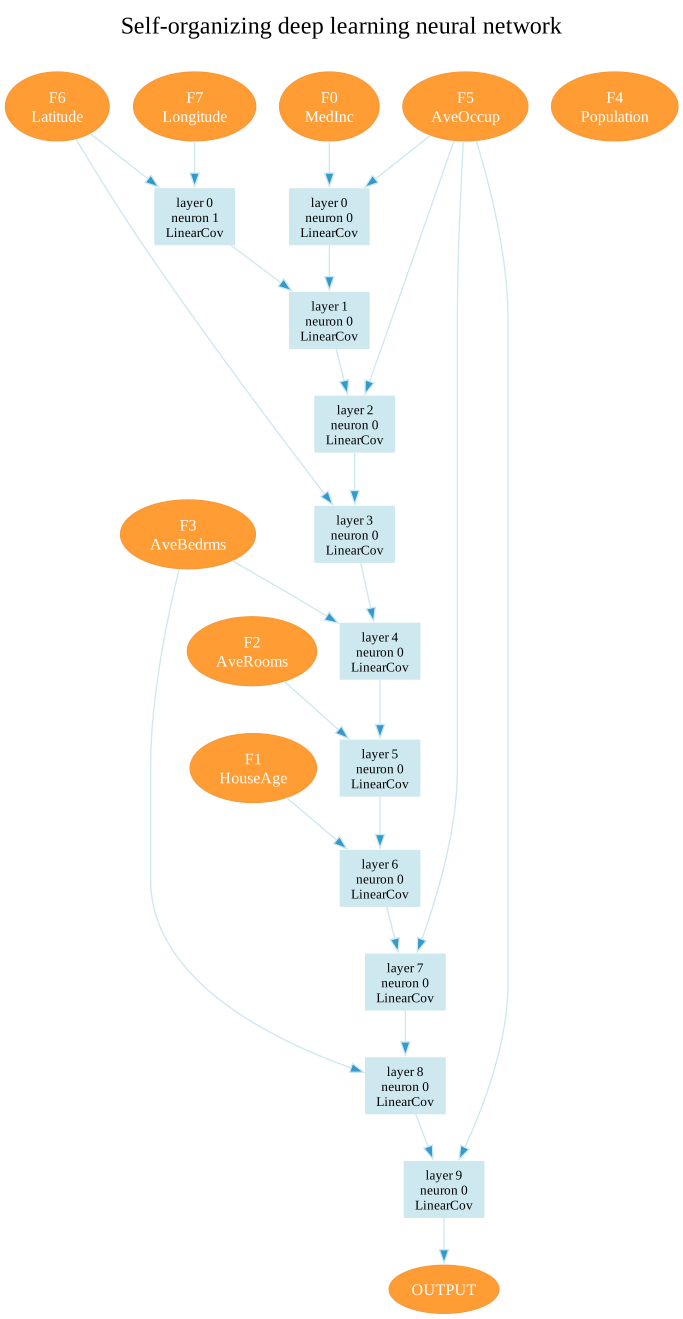
- The orange ovals at the top are the input features:
F<i>and the feature's name. The orangeOUTPUToval is the prediction. - Each blue box is a neuron: its layer, its position in the layer and, with
plot_neuron_name, its family's short name. - An arrow runs from each input of a neuron to the neuron. An arrow from a
feature into a deep layer comes from
model.shortcut.raw_features; withmodel.shortcut.prev_layers, arrows also skip from older layers. - The last arrow runs from the neuron that makes the prediction to
OUTPUT. A model with an output head draws anout_projbox instead, with an arrow from every survivor it reads. A multi-class model with a projection per candidate and no head draws aper-neuron projectionsbox, with an arrow from every survivor of its last layer.
Here each layer's neuron combines the neuron of the layer before with one
feature, a chain ten layers deep. F4 Population has no arrows: the model
does not use it.
Drawn before pruning, the diagram shows every survivor of every layer, 80 neurons for the quickstart, most of which never reach the output. Pruning first shows only what the prediction uses.
The layer errors
model.layer_err holds the error of every layer the search trained, the
numbers the growth rule compared, including the layers it trained past the
best one and then discarded. model.layer_val_err holds the same for the
validation split, when train was given one, and is empty otherwise.
model.plot_layer_error() plots layer_err against the layer index with
matplotlib and marks the last layer kept. It needs the viz extra.
Which features the model uses
Call these after prune. Before it, every survivor counts, including those
that never reach the output, and the quickstart's model lists all eight
features. get_selected_features_indices() and
get_unselected_features_indices() return column indices instead of
names. Names come from the feature_names given to SONN; without them,
the features read index=inp_<i>.
Inside a layer
model.layers lists the layers. A layer holds one module per neuron
family, and each module holds that family's survivors as the rows of its
tensors.
for i, layer in enumerate(model.layers):
    for module in layer:
        print(i, module.get_short_name(), tuple(module.weight.shape))
        for inputs in module.src_idxs.tolist():
            print("    reads", [model.locate(i, j) for j in inputs])
On the pruned quickstart model:
0 LinearCov (2, 4)
    reads [(None, 0), (None, 5)]
    reads [(None, 6), (None, 7)]
1 LinearCov (1, 4)
    reads [(0, 0), (0, 1)]
2 LinearCov (1, 4)
    reads [(1, 0), (None, 5)]
...
module.weighthas one row of coefficients per neuron. Forlinear_covthese are \(w_0, \dots, w_3\) of \(w_0 + w_1 x_i + w_2 x_j + w_3 x_i x_j\);module.get_name()prints the family's formula.module.src_idxsgives, per neuron, the positions of its inputs within the layer's input.model.locate(i, j)turns positionjof layeri's input into a source and an index: sourceNoneis the input features, a number is the layer whose output it is. Above, layer 2's neuron combines the output of layer 1's neuron 0 with feature 5,AveOccup.len(layer)is the number of neurons in the layer,layer.errits error andlayer.err_valuesits survivors' criterion values.
The training log
Every run writes its log to train.log in its run folder,
trainer.run_dir (see Training), and
torchsonn.logger.setup_logger() also shows it on the console. Each layer
of the quickstart logs:
All models of LinearCovPolynomNeuron early stopped at step 80
LinearCovPolynomNeuron fit: 81 optimizer steps; 1.5% of updates capped at max_step, 0.0% of curvature pairs rejected
Current layer error: 0.488
Layer errors: [0.488]
Executed train layer #0 in 7.72 sec
Layer #0: error 0.4879, best 0.4879 at layer 0; first layer; 0 of 5 layers without improvement
All models of ... early stopped at stepmarks the end of a family's fit by the early stop;... reached train.steps (N)marks a fit that the step budget ended.fit:counts the optimizer steps and, for LBFGS, how often its safeguards acted (see Optimizers).Current layer errorandLayer errorsgive the layer's error and those of the layers so far.Executed train layeris the layer's wall-clock time.Layer #k: error ...is the growth rule's verdict (see Splits and stopping).
Some settings add lines:
| Setting | Adds |
|---|---|
| a validation loader | a Layer #k: dev ... line per layer with the dev and validation errors and the gap between them |
train.layer_err_source: readout |
Layer readout error (per-layer head on dev): ...; best-neuron error: ... |
an rbf family |
where the input pass placed the centres, and how far the survivors moved them (see Gaussian RBF) |
train.log_layer_diagnostics |
the survivors' correlations and effective rank (see Survivor selection) |
Trainer.train_out_proj |
out_proj early stop at step ... (out_proj (lbfgs) ... under LBFGS) when the head fit stops early |
Trainer.train_finetune |
how the end-to-end pass runs and finetune early stop at step ... |
keep_best_weights |
after each head fit, per-layer fine-tune or end-to-end pass, the step whose weights it kept (see Heads and fine-tuning) |
A head fit or end-to-end pass whose log has no early-stop line ran to its
max_steps, and its result may not have converged.
Checked against TorchSONN 0.1.5.